Author name: Mac Sanford

Covering Cornwall, Mac Sanford is your local specialist for tile cleaning, stone cleaning, grout cleaning and tile, stone and grout sealing covering the restoration of all types of stone and tiled flooring including Ceramic, Limestone, Marble, Porcelain, Quarry, Sandstone, Slate, Terracotta, Terrazzo, Travertine and Victorian tile

Victorian Tiled Floor Renovation Lostwithiel Cornwall

Cleaning and Sealing a Victorian Tiled Floor at a Grade II Listed Property in Lostwithiel

Victorian tiled floors are a beautiful feature of period properties, and when they have been looked after for generations, they can add real character to a home. However, years of wear, ingrained dirt and deteriorating sealers can leave these original tiles looking tired and dull. The good news is that, in many cases, professional cleaning and restoration can bring them back to life without the expense and disruption of replacing them.

This was the situation when a client contacted us to discuss the restoration of a beautiful original Victorian tiled floor in the front reception room of their Grade II Listed property in Lostwithiel.

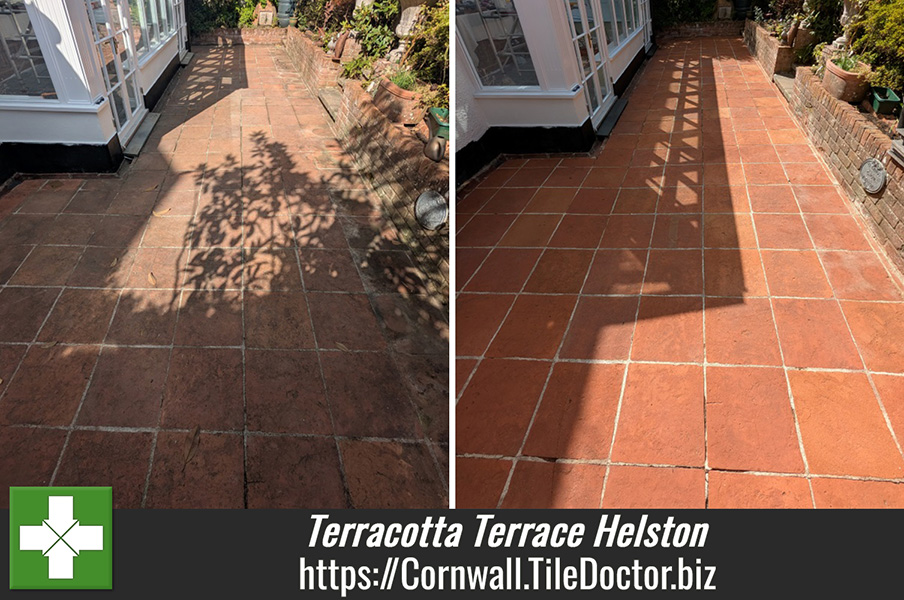
Victorian Tiled Floor Before Cleaning Lostwithiel

The floor featured traditional red hexagonal tiles surrounded by a striking geometric border of contrasting cream, red and dark tiles. Although the design remained intact, the surface had lost much of its appearance, with a worn and failing topical sealer affecting the finish of the tiles.

The client wanted to restore the floor and bring out the beauty of this original feature once again.

Assessing the Victorian Tiled Floor

Before recommending a restoration process, we visited the property in Lostwithiel to assess the condition of the Victorian tiles and carry out a test clean.

Test areas are an important part of our approach to tile and stone restoration. They allow us to evaluate how the surface responds to the proposed treatment and help us establish the most appropriate method for achieving the desired result.

The client was delighted with the improvement demonstrated by the test area, so happy with our quotation we agreed a date to return and carry out the full restoration.

Removing the Old Sealer and Deep Cleaning the Tiles

The first stage of the restoration was to remove the old, failing topical sealer. Over time, sealers can deteriorate and become uneven, detracting from the appearance of the tiles and making the floor harder to maintain.

To tackle this, we used coarse-grit diamond pads on a rotary floor machine, beginning with a relatively soft 50-grit diamond pad and Tile Doctor Pro-Clean diluted at a ratio of 5:1 water to solution.

The diamond pads were used with water lubrication, allowing us to work across the floor without generating the dust associated with dry grinding. The process also helped remove surface soiling and the unwanted sealer.

We then progressed through a sequence of diamond grits: 50, 100, 200, 400, 800 and 1500 grit. Working progressively through these grades refined the surface and helped close the pores of the porous clay tiles, preparing them for sealing.

This staged approach is particularly useful when restoring traditional tiled floors, as the aim is not simply to remove dirt. It is also to remove the deteriorated surface coating and create a suitable, consistent finish for the new sealer.

Once the old coating and surface soiling had been removed, the floor was ready for the next stage.

Neutralising the Floor and Allowing It to Dry

After the diamond-pad cleaning process, we treated the floor with Tile Doctor Grout Clean-Up, an acidic cleaner used here to neutralise the floor following the alkaline cleaning stage.

The floor was then left to dry thoroughly before sealing.

Because the diamond pads require water lubrication, a considerable amount of water had been used during the restoration. We therefore allowed several days for the tiles to dry before returning to complete the work.

Drying is especially important when working with Victorian tiled floors. Many original installations were laid without a modern damp-proof membrane (DPM), and their porous clay tiles can absorb moisture from the ground beneath the property.

As this moisture evaporates, it can sometimes carry soluble salts to the surface, creating white deposits known as efflorescence. These deposits can interfere with the appearance of a newly restored floor and may affect the performance of the sealer.

Fortunately, this floor showed no signs of salt deposits emerging during the drying period, so no additional treatment for efflorescence was required.

Sealing the Victorian Tiled Floor

Once the floor was sufficiently dry, we applied two coats of Tile Doctor X-Tra Seal which is an oil-based impregnating sealer designed to protect suitable porous tile and stone surfaces. It was selected for this project to provide protection while enriching the colours of the original tiles.

Choosing the right sealer is an important part of Victorian tile restoration. A suitable sealer helps protect porous tiles against everyday dirt and staining, while enhancing their appearance and making routine cleaning easier.

After applying the two coats, we buffed the floor using a white pad on the rotary machine. This final step helped even out the finish and leave the surface looking consistent.

A Beautiful Original Feature Restored

The completed floor looked considerably fresher, with the rich red tiles and contrasting geometric border once again standing out as a feature of the reception room.

Victorian Tiled Floor After Renovation Lostwithiel

The clients were so pleased to see this beautiful original feature in their home sing again. The real benefit was being able to enjoy this beautiful original floor again rather than consider the cost and disruption of replacing it.

For aftercare I left the customer with a bottle of Tile Doctor Neutral Tile Cleaner which is a ph neutral tile cleaner that will effectively clean the floor without impacting the sealer.

This project demonstrates why professional Victorian tiled floor cleaning and sealing can be such a worthwhile investment for owners of period properties. With the correct equipment, suitable cleaning products and a carefully managed restoration process, an old floor can often be transformed while preserving the character that makes it special.
Professional Renovation of Victorian Tiled Floors in Corwall

Cleaning and Sealing a Victorian Tiled Floor at a Grade II Listed Property in Lostwithiel Read More »

Spanish Terracotta Tiled Terrace Renovation Helston

Renovation of a 40m² Spanish Terracotta Tiled Terrace in Helston

Following extensive exterior building work at their property just outside Helston in Cornwall, this homeowner wanted to give the outside of their property a thorough makeover. A particular priority was the restoration of their beautiful Terracotta tiled terrace, which had been imported from Spain and laid several years previously.

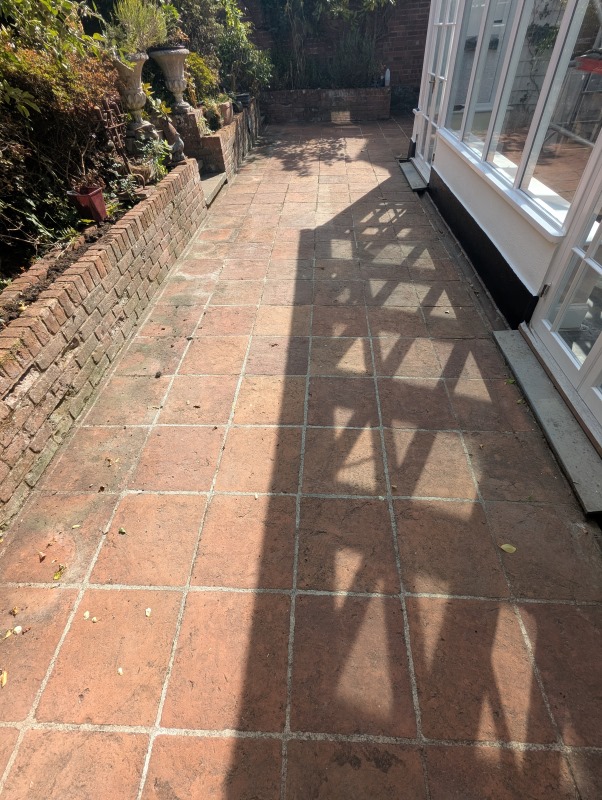
Although the terracotta tiles were still in good condition, years of exposure to the elements had left the terrace looking tired and weathered, with surface growth, ingrained dirt and areas of cement staining left behind during the building work.

Spanish Terracotta Tiled Terrace Before Renovation Helston

We provided two quotations for the work: one for the complete terracotta terrace cleaning and sealing, including remedial lime pointing, and another for the tile restoration without the pointing work. The client decided to concentrate on restoring and protecting the terracotta tiles for now, with the lime pointing to be addressed later.

Deep Cleaning Spanish Terracotta Patio Tiles

The first stage was to remove the surface dirt and organic growth from the approximately 40m² terracotta terrace. We used a 17-inch black fibre pad, which provides effective cleaning without being overly abrasive, together with water to remove the initial layer of surface contamination.

The terrace was then treated with a diluted sodium hypochlorite-based cleaning solution. This was used to kill algae and other organic growth that had become established on the terracotta over time.

The cleaning solution was carefully agitated using a soft carbide brush head fitted to a rotary cleaning machine. Plenty of fresh water was used during the process to lift and remove the loosened dirt and contamination from the textured surface of the terracotta tiles.

Removing cement staining

Once the initial cleaning was complete, we identified areas of cement-based staining left on the tiles following the recent building work.

To tackle this, the terracotta was treated to an acid wash using Tile Doctor Grout Clean-up which was applied and gently agitated using a soft polypropylene brush fitted to the rotary machine. This helped to break down the remaining cement residue without unnecessarily damaging the surface of the original Spanish terracotta tiles.

After cleaning, the terrace was allowed to dry thoroughly before the sealing stage.

Sealing and Protecting Terracotta Terrace Tiling

Once completely dry, we returned to apply two coats of Tile Doctor X-Tra Seal, an oil-based exterior sealer designed for use on suitable exterior tile and stone surfaces.

The sealer immediately enhanced the natural character of the Spanish terracotta, bringing out the rich red and earthy colours of the clay tiles while retaining their natural appearance. Importantly for an exterior terrace, the treatment also allows the terracotta to remain breathable.

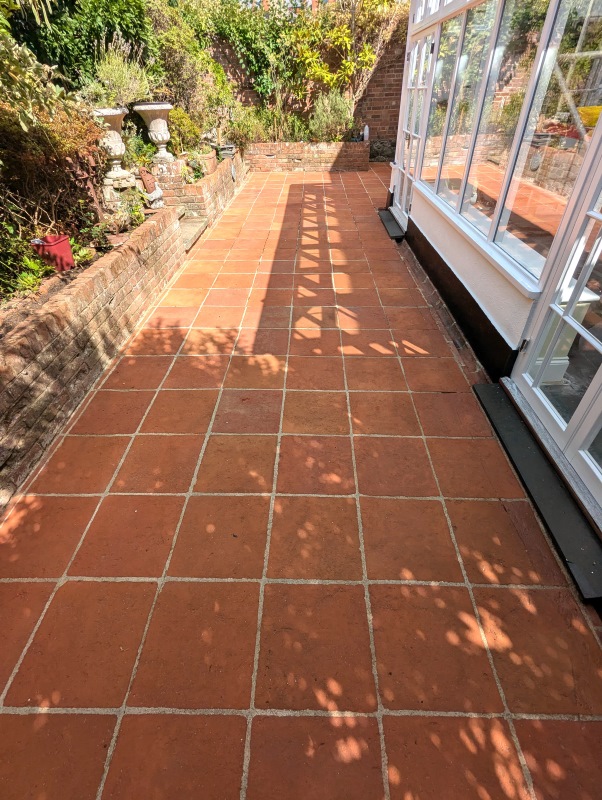
Spanish Terracotta Tiled Terrace After Renovation Helston

The transformation was particularly pleasing for the homeowner. They told us that the restored terrace reminded them of how the tiles looked when they were originally laid.

The clients were delighted with the finished result and have now signed up to an annual spring maintenance programme. This will help keep their terracotta terrace clean, protected and looking its best throughout the summer months. For regular cleaning I recommended they should use Tile Doctor Neutral Tile Cleaner which is a mild but effective cleaner that’s sealer safe and designed for cleaning sealed tile and stone.

Terracotta Terrace Tile Cleaning and Renovation in Cornwall

This project demonstrates how an established terracotta tiled terrace doesn’t necessarily need replacing simply because it has become dirty, weathered or stained. With the correct cleaning methods, stain removal and appropriate sealing, original terracotta tiles can often be restored and their natural colour and character brought back to life.

If your terracotta patio, terrace or tiled floor in Helston, Cornwall or the surrounding area has become dirty, weathered, stained or affected by algae and organic growth, a professional assessment can establish what cleaning and restoration treatment is appropriate.

Renovation of a 40m² Spanish Terracotta Tiled Terrace in Helston Read More »

Marble Tiled Ensuite Floor Polishing Penzance

Marble Tiled Bathroom Floor Renovated in Penzance Holiday Rental

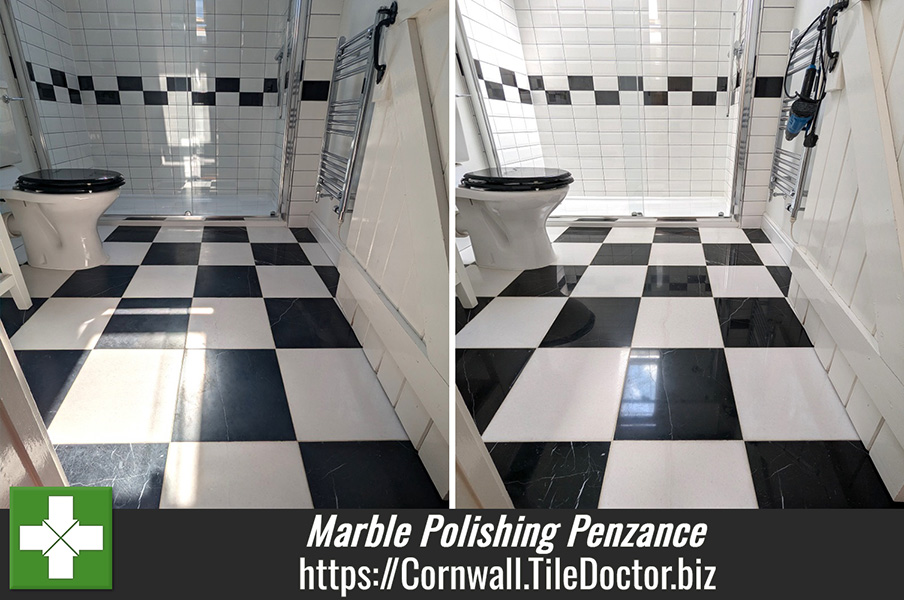
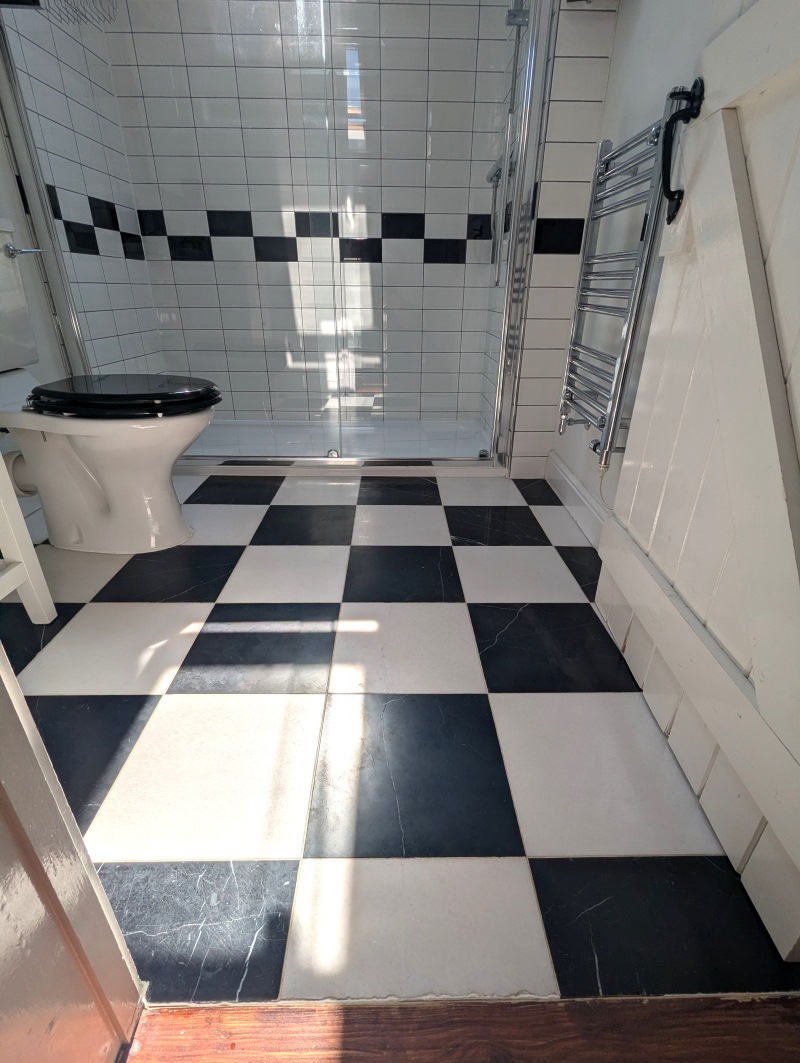
This client has a high turnover holiday let in Penzance and wanted the Marble tiled en-suite floor cleaned mid-season. The tiles were laid in a classic Black & White checkerboard pattern and as you can see from the photograph below were looking dull and lacklustre.

Marble Tiled Ensuite Floor Before Cleaning Penzance

We try and accommodate a customer’s needs where possible and, in this case, we had to fit around the property bookings which was a challenge as it was a popular rental. Working from a photo we were able to work out a price and a date was found in the schedule.

Cleaning a Marble Tiled Bathroom Floor

Hard stone surfaces like Marble need to be honed with a set of burnishing pads to get the best from them so I started the cleaning with the application of a 400-grit diamond pad lubricated with water. These pads fit a floor buffer machine and will remove any surface damage such as etching caused by acidic substances around the toilet and wash basin. The soiling generated by the pad was then rinsed off with water and extracted with a wet vacuum.

Once this was complete attention turned to cleaning the grout which was done by scrubbing in Tile Doctor Pro-Clean. This is a strong alkaline cleaner that is safe to use on stone and once done the floor was rinsed and extracted as before.

Burnishing then continued with the finer 800 and 1500-grit pads again applied with water rinsing and extracting afterwards. These finer pads bring up the polish on the stone and is completed with an extra fine 3500-git pad which is applied dry with only a little water sprayed onto the tile.

Sealing a Marble Tiled Bathroom Floor

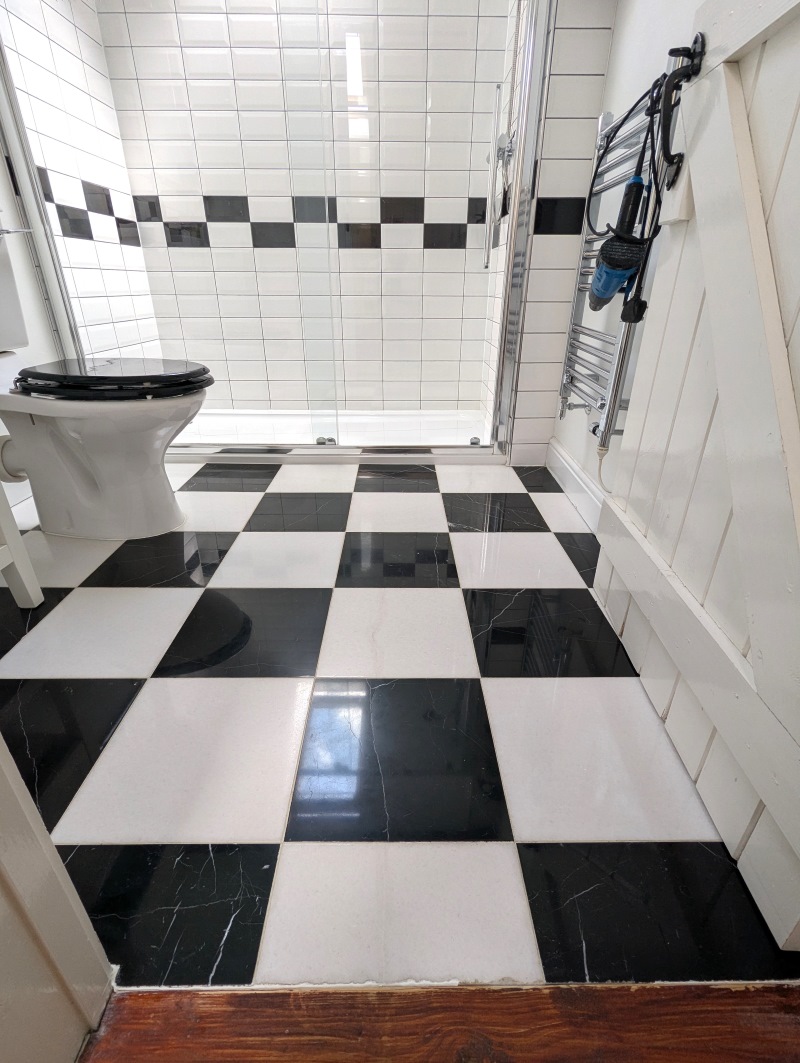
Once dry, the Marble was looking good but not quite as polished as one wanted, also with the floor getting a lot of use it needed a very durable polish. To achieve this Tile Doctor Shine Powder was worked into the stone using a little water and a white buffing pad. The result was a very durable and deep mirror finish.

When fully dry and buffed clean, the floor was sealed with two coats of Tile Doctor Colour Grow with is an impregnating sealer that works by soaking into the pores of the stone ensuring dirt remains on the surface. This product has a colour intensifying formula which worked perfectly to darken the black stones and make the floor pop.

Marble Tiled Ensuite Floor After Renovation Penzance

The result was a happy client who could reopen for bookings the following day.

For the aftercare of Marble tiles, I recommend the use of Tile Doctor Stone Soap which is a mild yet effective cleaner that helps maintain polish. Its also pH neutral so won’t impact the sealer.


Professional Renovation of a Marble Tiled Bathroom Floor in Cornwall Holiday Let

Marble Tiled Bathroom Floor Renovated in Penzance Holiday Rental Read More »

Black and White Victorian Hallway Deep Cleaned in Newquay

Black and White Victorian Hallway Deep Cleaned in Newquay

This Victorian tiled hallway at a house in the coastal town of Newquay actually dates back to the 1920 as opposed to the Victorian era, however the method of making them didn’t really change until after the 2nd World War, as such Victorian and Edwardian tiles can all be cleaned using the same methods. The tiles had actually been hidden under carpet and you can still see the carpet gripper and adhesive along the perimeter of the floor in the photographs below:

Old victorian tiled floor before cleaning in Newquay Old victorian tiled floor before cleaning in Newquay

Cleaning Victorian Floor Tiles

Before starting the clean I took several readings with a damp meter to understand if there were any underlying damp issues that may have been exacerbated, most of these old floors have no damp proof course so it’s always good to understand the inherent level of dampness in the floor before starting.

Fortunately there was no evidence of major dampness so I proceeded with the cleaning by applying a dilution of Tile Doctor Pro-Clean which is an effective alkaline cleaner that is safe to use on these tiles and left it to dwell on the floor for ten minutes before working it in with a Rotary Machine fitted with a scrubbing pad. It was then time to break out a stiff brush to get into the grout lines where the pads can struggle to reach. The last step was to remove the soiled cleaning solution with a wet vacuum and give the floor a rinse with Acid Gel which keeps the Alkaline salts in the floor at bay and avoids any efflorescence issues that are quite common with these old floors.

Sealing the Victorian Tiled Floor

I came back the following day and damp tested several areas again to make sure the floor was dry; the results confirmed the floor had dried and ready for sealing. I sealed the floor using five coats of Tile Doctor Seal and Go which provides the satin finish the customer wanted whilst offering excellent stain protection. You have to leave each coat to dry before applying the next so this process can take some time.

Old victorian tiled floor after cleaning in Newquay Old victorian tiled floor after cleaning in Newquay


Deep Cleaning Victorian Tiles in Cornwall

Black and White Victorian Hallway Deep Cleaned in Newquay Read More »

╳
Scroll to Top